If you only record one or two sources at a time, you probably do not need a giant rack full of inputs. A great 2-channel audio interface can give you professional preamps, excellent conversion, low-latency monitoring and enough flexibility to build a serious home studio without taking over your desk.
But “2-channel” gets a little slippery once you enter higher-end interfaces. Some models in this guide have two main microphone preamps but add extra line inputs, outputs, ADAT expansion or DSP. The RME Babyface Pro FS, for example, definitely belongs in the two-preamp club, but it brought ADAT and TotalMix to the party.
For this guide, we are focusing on compact interfaces built around two primary recording channels or microphone preamps. That makes them particularly useful for home studios, producers, vocalists, instrumentalists, electronic musicians and anyone who usually records one or two things at once.
If you need significantly more I/O, see our guide to the best audio interfaces for music production or our rackmount and multichannel audio interface comparison.
Quick Comparison: Best 2-Channel Audio Interfaces in 2026
Prices below are in CAD and were checked in October 2026. Pricing and availability can change.
| Rank | Interface | Analog I/O | Mic Preamps | Digital Expansion | Max Resolution | Price | Best For |
|---|---|---|---|---|---|---|---|
| 10 | Focusrite Scarlett 2i2 4th Gen | 2-in / 2-out | 2 | No | 24-bit / 192 kHz | $309 | Familiar all-round starter |
| 9 | Arturia MiniFuse 2 | 2-in / 2-out | 2 | No | 24-bit / 192 kHz | $219.99 | Software bundle and value |
| 8 | MOTU M2 | 2-in / 2-out | 2 | No | 24-bit / 192 kHz | $275 | Metering and straightforward recording |
| 7 | Yamaha URX22 | 4-in / 2-out | 2 | No | 32-bit / 192 kHz | $519.99 | Music, streaming and creator workflows |
| 6 | Universal Audio Volt 2 Gen 2 | 2-in / 4-out | 2 | No | 32-bit / 192 kHz | $309 | Tone shaping and modern workflow tools |
| 5 | Audient iD14 MKII | 2-in / 4-out native | 2 | 8-channel ADAT input | 24-bit / 96 kHz | $449 | Compact studios that may expand later |
| 4 | Apogee BOOM | 2-in / 2-out | 1 mic preamp + second line/instrument input | No | 24-bit / 192 kHz | $369 | Premium conversion and onboard DSP |
| 3 | UA Apollo Twin X DUO Gen 2 | 10-in / 6-out total | 2 Unison | Optical ADAT / S/PDIF input | 24-bit / 192 kHz | $1,659 | Realtime UAD plug-in recording |
| 2 | RME Babyface Pro FS | 4 analog in / 4 analog out + phones | 2 | ADAT I/O | 24-bit / 192 kHz | $1,425 | Premium portable recording and routing |
| 1 | SSL 2+ MKII | 2-in / 4-out | 2 | No | 32-bit / 192 kHz | $439 | Best overall balance of sound, workflow and value |
Price Comparison: 2-Channel Audio Interfaces
This chart shows current Moog Audio pricing from lowest to highest. Price does not automatically equal better sound or a better fit for your studio, but it helps show how dramatically the category stretches from entry-level interfaces to premium professional systems.
Prices checked in October 2026. Current pricing and promotions can change.
10. Focusrite Scarlett 2i2 4th Gen: The Familiar Starting Point
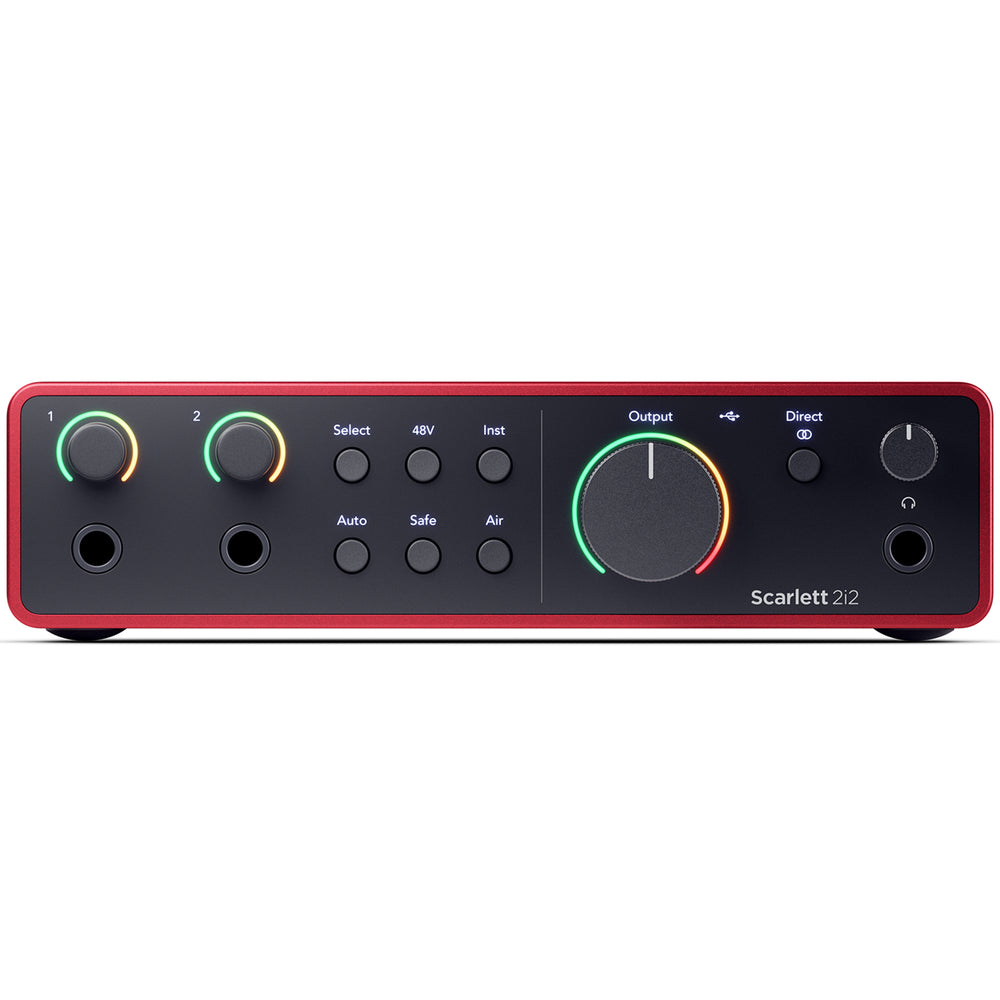
The Focusrite Scarlett 2i2 4th Gen may be the interface almost everyone has encountered at some point.
Putting it at number 10 is not a knock against it. The 2i2 is a very capable 2-in / 2-out interface with two fourth-generation preamps offering up to 69 dB of gain, Hi-Z instrument inputs and 24-bit / 192 kHz conversion.
Focusrite's Air modes give you two tonal options, while Auto Gain and Clip Safe make recording levels easier for beginners to manage. Dynamic Gain Halos provide immediate visual feedback, and loopback makes it useful for streaming and sampling computer audio.
The Scarlett is the safe, familiar reference point in this comparison. The reason it sits lower in our list is simply that several competitors now offer unusually strong software bundles, routing, DSP, expandability or monitoring features at similar prices.
Best for: first-time producers who want a proven, uncomplicated home studio interface.
Explore the Focusrite Scarlett 2i2 4th Gen at Moog Audio →
9. Arturia MiniFuse 2: Best Value for Software and Music Creation
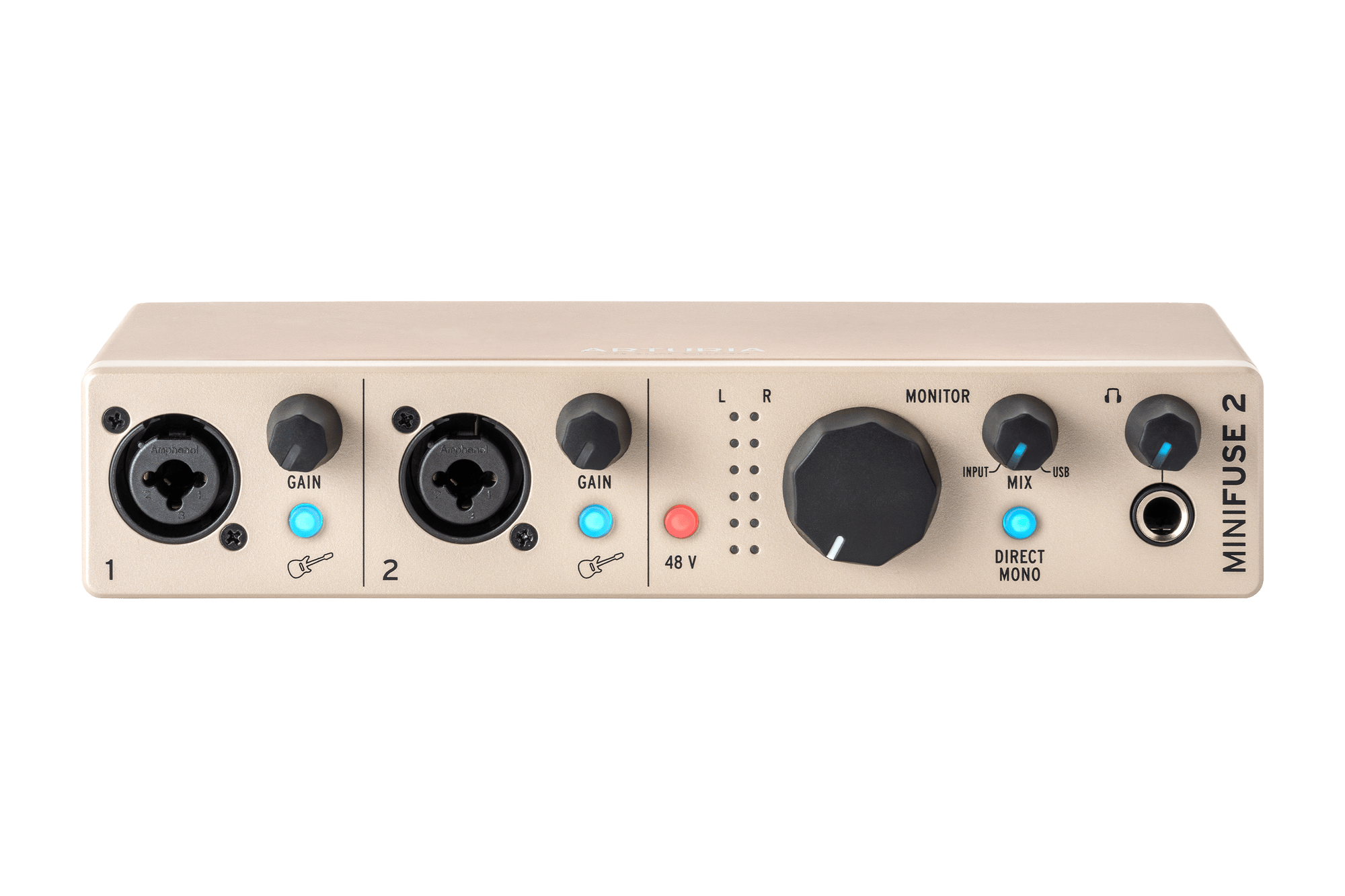
The Arturia MiniFuse 2 is one of the least expensive interfaces in this list, but the package surrounding it is unusually strong.
You get two mic, line and instrument inputs, stereo outputs, MIDI I/O, loopback and a built-in USB hub for connecting another USB device to your setup.
Where Arturia really sweetens the deal is software. MiniFuse comes with music-production tools including Analog Lab Intro, giving you hundreds of playable keyboard, synth and instrument sounds from Arturia's ecosystem. This software alone is $99 USD, so around $150 CAD after tax, and has 500 sounds from unreal virtual synths. Their virtual instruments can keep you making music for days.
That makes the MiniFuse particularly attractive for someone starting an entire music-production setup rather than simply replacing an existing interface. The included software can immediately become part of the creative process.
Best for: new producers, compact setups and anyone who values bundled software as much as hardware specifications.
Explore the Arturia MiniFuse 2 at Moog Audio →
8. MOTU M2: Best Front-Panel Metering in the Affordable Class
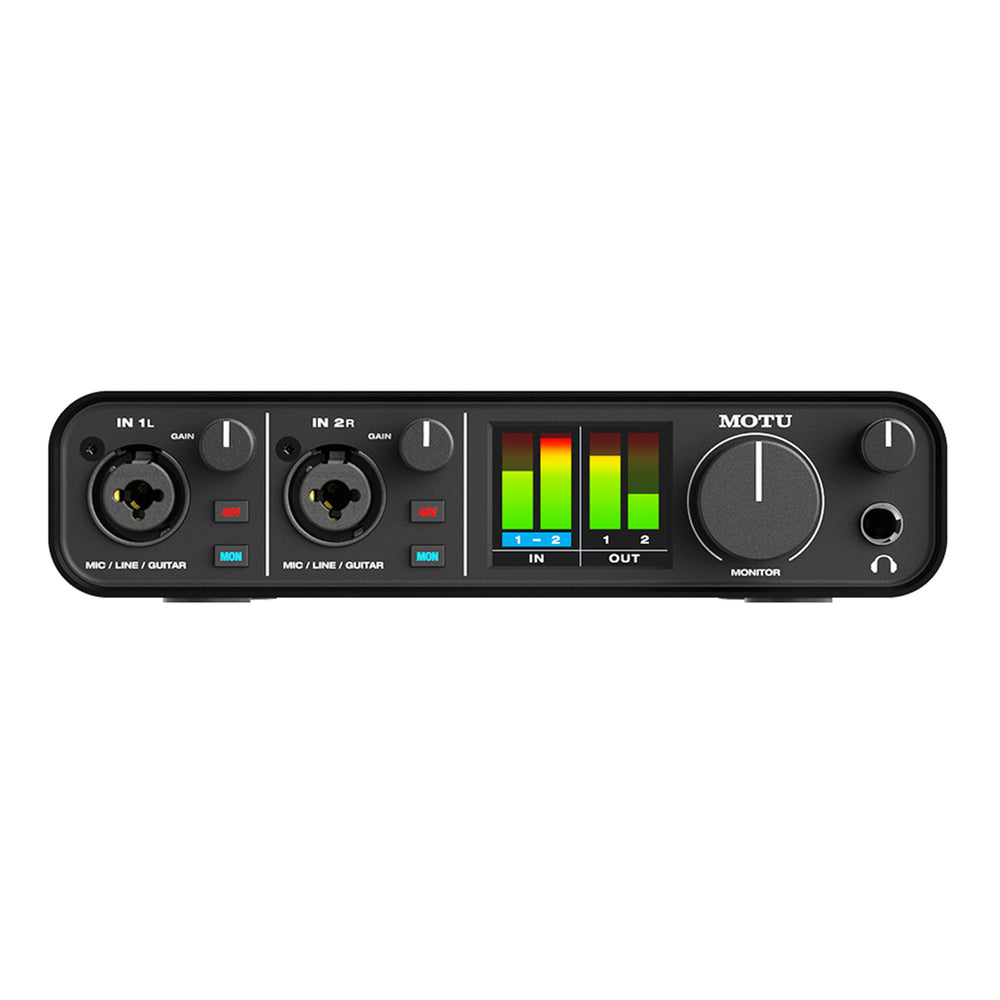
The MOTU M2 keeps the workflow simple while giving you something surprisingly useful at this price: proper full-colour front-panel metering.
It provides two mic, line and Hi-Z inputs, MIDI I/O, independent headphone control and recording up to 24-bit / 192 kHz.
MOTU uses ESS Sabre32 Ultra DAC technology in the M2, and the balanced TRS outputs are DC-coupled, which can also be useful for musicians integrating compatible modular or CV-controlled instruments.
If you want a straightforward compact interface and do not need DSP or ADAT expansion, the M2 remains an excellent little studio hub.
Best for: musicians who want clear metering, straightforward controls and excellent basic recording functionality.
Explore the MOTU M2 at Moog Audio →
7. Yamaha URX22: Best for Music, Streaming and Content Creation

The new Yamaha URX22 pushes well beyond the traditional two-preamp desktop interface.
It is a 4x2 USB-C audio interface with two XLR/TRS mic, line and Hi-Z inputs offering up to 78 dB of gain, stereo line outputs, two headphone outputs and multiple auxiliary connections.
It also records at up to 32-bit / 192 kHz and includes onboard DSP with gate, compression, EQ, reverb, amp simulation and pitch correction.
The touchscreen is a major part of the workflow. Routing, mixing and effects can be controlled directly on the interface, while Auto Gain helps set recording levels and Clip Safe protects against unwanted distortion.
One of its most unusual features is dual USB-C connectivity. The Main USB connection supports a larger multi-track recording and playback workflow while the Sub connection can simultaneously handle a second 2-track device. That makes the URX22 especially interesting for musicians whose work overlaps with streaming, video, podcasting and online content.
The URX22 is also available in black if the white edition is not your studio's aesthetic destiny.
Best for: musicians, streamers, podcasters and hybrid creators who want recording, monitoring and content-production tools in one compact interface.
Explore the Yamaha URX22 at Moog Audio →
6. Universal Audio Volt 2 Gen 2: Best New Interface for Tone Shaping

The Universal Audio Volt 2 Gen 2 brings some welcome personality to the affordable interface category.
Its two Tone Shaping Preamps provide up to 60 dB of gain and include three selectable characters called Warmth, Focus and Shine. You also get Auto-Gain, Clip Protection, independent phantom power and a full-colour Smart Display.
It records at up to 32-bit / 192 kHz and provides four outputs, which makes it more flexible than a basic 2x2 interface for routing or alternate monitoring.
The trade-off is that this particular Volt 2 model does not include MIDI or optical digital expansion. If you need those, look farther up the Volt family.
Best for: vocalists, instrumentalists and producers who want hands-on tonal options without moving into a large studio interface.
Explore the Universal Audio Volt 2 Gen 2 at Moog Audio →
5. Audient iD14 MKII: Best Compact Interface for Future ADAT Expansion
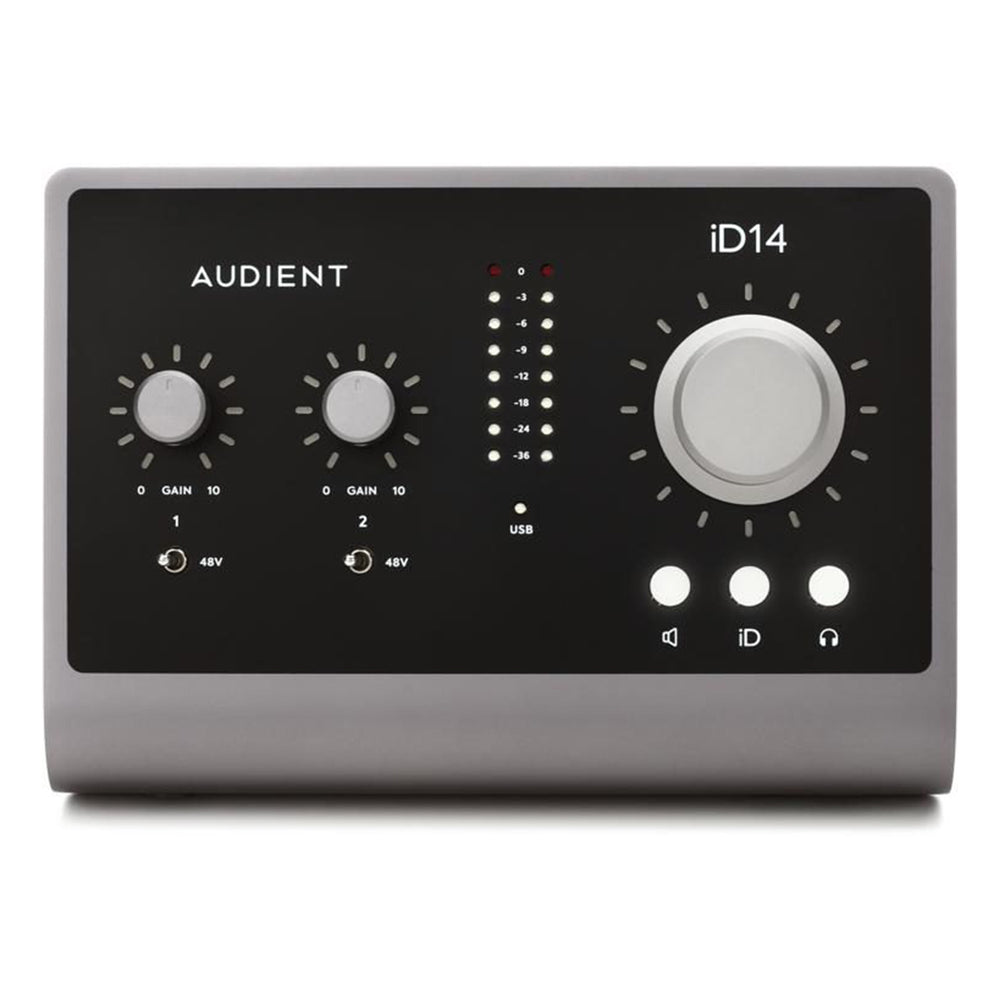
The Audient iD14 MKII solves one of the biggest problems with buying a small interface: what happens when your studio grows?
Out of the box, it gives you two Audient Class A console microphone preamps, Burr-Brown conversion, a discrete JFET instrument input and four outputs.
But its optical ADAT input lets you add up to eight additional input channels using an external preamp or converter.
That means you can begin with a clean two-preamp desktop setup and later connect a multi-channel expansion unit instead of throwing the entire interface away.
Best for: home studios that only need two preamps today but expect to record more channels later.
Explore the Audient iD14 MKII at Moog Audio →
4. Apogee BOOM: Best Compact Interface with Onboard DSP

The Apogee BOOM is technically a 2x2 interface, but there is an important detail: it has one full microphone preamp plus a second line/instrument input rather than two identical microphone preamps.
For solo creators, that layout may be completely fine.
BOOM records at up to 24-bit / 192 kHz and includes onboard hardware DSP running Apogee's Symphony ECS Channel Strip, developed with mixer Bob Clearmountain. That gives you EQ, compression and analogue-style drive without relying entirely on native computer processing.
If your priority is premium compact conversion and you generally record one microphone at a time, BOOM is a compelling little machine.
Best for: solo musicians, vocalists, streamers and creators who value onboard processing and Apogee conversion.
Explore the Apogee BOOM at Moog Audio →
3. Universal Audio Apollo Twin X DUO Gen 2: Best for Realtime UAD Processing

The Apollo Twin X DUO Gen 2 is where the two-preamp category starts behaving like a much larger studio system.
You get two Unison microphone preamps, elite-class 24-bit / 192 kHz Apollo conversion and DUO Core DSP for recording through compatible UAD plug-ins in realtime.
The optical input supports ADAT or S/PDIF, allowing the system to grow beyond its two physical mic preamps. Apollo Monitor Correction powered by Sonarworks, alternate speaker switching, integrated talkback, Auto-Gain and Bass Management push it even further into monitor-controller territory.
This interface makes the most sense if you specifically want to enter the Universal Audio ecosystem. A large part of what you are paying for is the workflow surrounding the hardware.
Best for: producers who want realtime UAD plug-in processing, Unison preamps and an expandable premium desktop studio.
Explore the Apollo Twin X DUO Gen 2 at Moog Audio →
2. RME Babyface Pro FS: Best Premium Portable Audio Interface
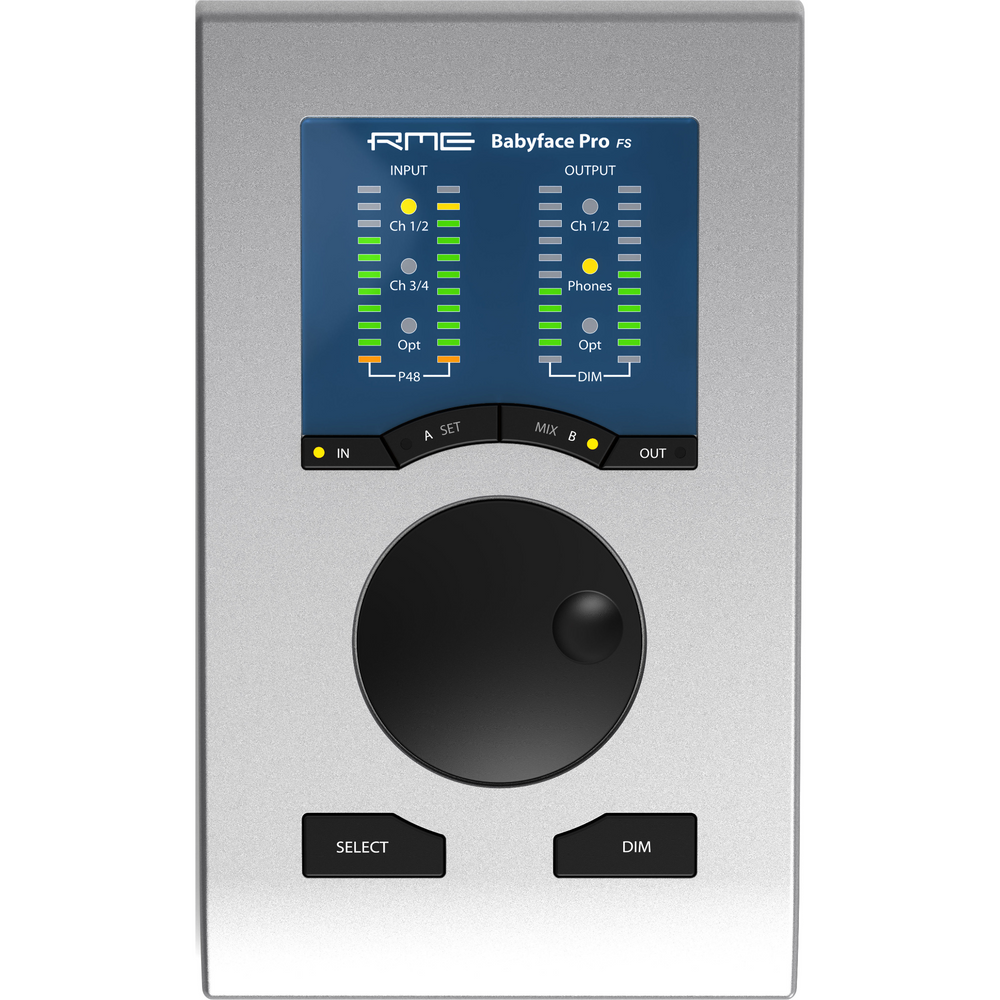
Does the RME Babyface Pro FS count as a two-channel interface?
Yes. Sort of. It has two digitally controlled microphone preamps. But it also has additional line and instrument inputs, ADAT I/O, MIDI, TotalMix FX and enough expansion potential to escape the category almost immediately.
With an external ADAT converter, the Babyface can become the centre of a considerably larger recording system while still fitting into a compact, bus-powered format.
RME's SteadyClock FS clocking, TotalMix routing and long-standing reputation for driver stability are major reasons people move into this price bracket.
This is not the value choice. It is the “I want a compact interface that I can still take very seriously ten years from now” choice.
Best for: professional mobile recording, demanding producers, live rigs and studios that want RME routing and expandability in a compact format.
Explore the RME Babyface Pro FS at Moog Audio →
1. SSL 2+ MKII: Our Best 2-Channel Audio Interface Pick

Our top pick is the SSL 2+ MKII.
Not because it has the longest specification sheet in this guide. The Babyface and Apollo can both build into significantly larger systems.
The SSL wins here because of the balance.
You get two SSL-designed microphone preamps, 32-bit / 192 kHz conversion, four balanced line outputs, two independent headphone outputs and selectable Legacy 4K analogue enhancement inspired by SSL's 4000-series consoles.
The outputs are also DC-coupled, which makes the 2+ MKII unusually friendly to electronic musicians working with compatible modular synthesizers and CV-controlled gear.
At $439 CAD, it occupies an appealing space between entry-level interfaces and high-end desktop systems. The preamps are juicy, monitoring is flexible, the layout makes sense, and it gives you a little SSL magic without requiring SSL-rack money.
Best for: producers, vocalists, instrumentalists and electronic musicians who want an excellent compact interface without jumping into four-figure territory.
Explore the SSL 2+ MKII at Moog Audio →
Which 2-Channel Audio Interface Should You Buy?
If budget is the priority: start with the Arturia MiniFuse 2.
If you want a simple traditional interface: the Scarlett 2i2 and MOTU M2 remain easy recommendations.
If music production overlaps with streaming, video or content creation: the Yamaha URX22 offers one of the most unusually complete workflows in this comparison.
If you expect your studio to expand: look closely at the Audient iD14 MKII, Apollo Twin X or RME Babyface Pro FS because they offer digital expansion.
If realtime plug-in processing matters: Apollo Twin X is the obvious specialist.
If portability and deep routing matter: the Babyface Pro FS is in another league.
If you want our favourite balance of price, preamps, monitoring and musician-friendly features: the SSL 2+ MKII takes the top spot.
Do You Need More Than Two Inputs?
Maybe.
A compact two-preamp interface makes sense if you mostly record one vocalist, one instrument, a stereo keyboard or a pair of microphones at a time.
But hardware studios grow quickly. Two stereo synthesizers already require four line inputs.
If your gear is multiplying, read our Best Audio Interfaces for Music Production in 2026.
If words like ADAT, MADI, Dante, Word Clock and 32-channel routing are already part of your shopping list, skip directly to our Best Rackmount Audio Interfaces in 2026.
Want to compare audio interfaces in Montreal?
Visit Moog Audio in Montreal to compare available interfaces in person, or call (514) 284-7434 to check store availability before visiting.